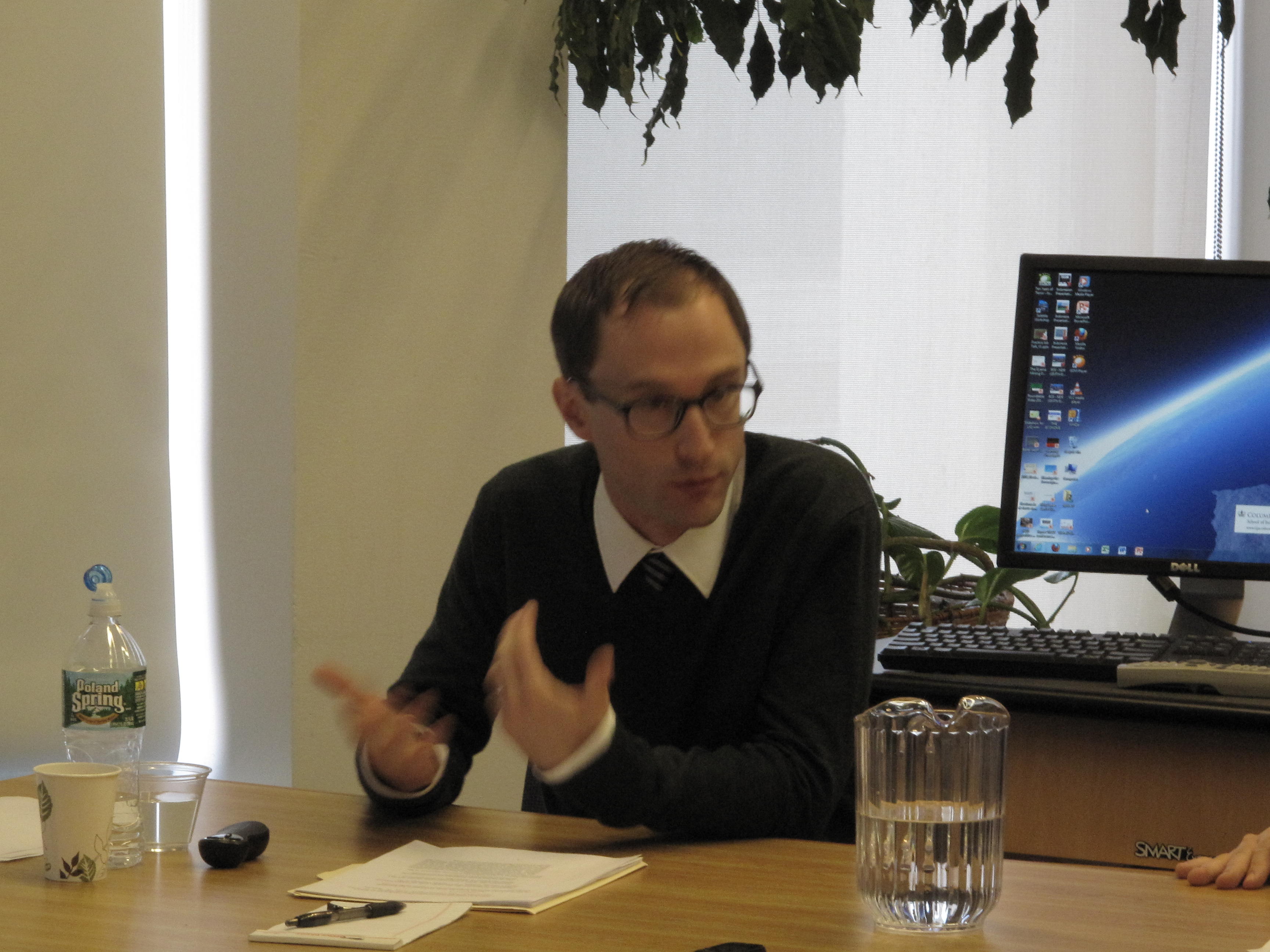
Pictures from the Brown Bag on North Korea’s Second Economy co-sponsored by the Center for Korean Research, the APEC Study Center, and the Institute for the Study of Human Rights on Thursday, November 21…
Alexander Dukalskis, Visiting Scholar, Institute for the Study of Human Rights, Columbia University; Political Science & Peace Studies Lecturer, University of North Carolina at Chapel Hill, and moderator Charles Armstrong, Korea Foundation Professor of Korean Studies in the Social Sciences in the Department of History, Columbia University, discussed the political consequences of the second economy in North Korea on November 21.
Dr. Dukalskis shared his research on the second economy – those markets inconsistent with government ideology or law – and the impact it has on the North Korean regime’s stability. Through a discussion on the history of the second economy, a survey of literature on this topic, hypotheses from other totalitarian states, and his original research, Dr. Dukalskis came to the conclusion – however tentative given the paucity of data in that country – that the underground market has more of a stabilizing than a subversive influence on the government. This is due to a few factors: there is much official presence and buy-in within the underground markets; they allow the elite of the country to acquire more wealth, keeping them satisfied; they allow small business owners to make enough money to leave the country if they are unsatisfied, thus ridding the country of potential dissidents; and they are tightly controlled, preventing the types of gatherings that can lead to revolutions.
Audio for this event is unfortunately not available.